Proper maintenance of smoke and heat extraction systems: security, obligations and liability
Regular maintenance of smoke and heat extraction systems is essential to ensure that they function reliably in an emergency and that operator obligations are met. For building operators, facilities managers and those responsible for building services, this is not just a matter of technical operational readiness, but also of security, documentation and minimising liability. Find out what is important when it comes to smoke and heat extraction maintenance and documentation, which regulations and inspection intervals apply, who is authorised to carry out the maintenance, and what is essential for professional maintenance.
How often does a smoke and heat extraction system need to be serviced?
SHEV system from GEZE © GEZE GmbH
As a rule, a smoke and heat extraction system must be serviced at least once a year or within a one-year period. The actual maintenance interval may be shorter for some systems. Depending on the system, the technology installed, the manufacturer’s specifications and the building’s usage, shorter maintenance intervals may also be required. In addition, any requirements set out in the fire protection concepts, building regulations or operator obligations must be observed. In many federal states, smoke and heat extraction systems must be inspected at regular intervals by a certified expert, in addition to their annual maintenance. These periodic inspections are laid down in the relevant regional regulations and are typically carried out every 3 to 6 years, depending on the federal state.
What is the difference between smoke and heat extraction system maintenance and inspection?
In short: The periodic smoke and heat extraction inspection ensures that the system is functioning correctly and is in working order. Professional smoke and heat extraction system maintenance also includes all measures necessary to ensure the system remains fully functional in the long term, such as inspection, cleaning, adjustment and, where necessary, replacing worn components.
GEZE smoke and heat extraction maintenance contract: contact us nowWhat regulations and standards apply to the maintenance and inspection of smoke and heat extraction systems?
Under Section 14 of the Model Building Code (MBO), buildings must be laid out, constructed, renovated and maintained in such a way as to prevent the outbreak of fire and the spread of fire and smoke, and to ensure that effective fire-fighting operations are possible in the event of a fire. The specific details are set out in the relevant Building Codes of federal states, Technical Building Rules and the applicable product and system standards. The specific regulations that apply to the maintenance of smoke and heat extraction systems depend on the type of building, the relevant regional legislation and the components installed in the system. The operator’s legal obligations, as well as the requirements set out in standards, statements of approval and manufacturers’ documentation, are decisive.
In Germany, smoke and heat extraction system maintenance is, in practice, governed by a combination of:
- Building regulations and supplementary provisions under fire safety legislation
- Product standards such as DIN 18232 and the European standard DIN EN 12101
- Manufacturer’s and approval documentation
Who is authorised to carry out maintenance and inspections on a smoke and heat extraction system?
GEZE Service takes care of the maintenance and inspection of your smoke and heat extraction system. © Karin Fiedler / GEZE GmbH
In addition to the legal requirements, there is the practical question of to who is authorised to carry out the maintenance. Maintenance of a smoke and heat extraction system must only be carried out by a competent and qualified specialist company or trained specialist personnel. Key requirements include knowledge of smoke and heat extraction technology, appropriate technical expertise in accordance with the relevant regulations, and, as a rule, product-specific training provided by the manufacturer. This is supported by the DIN 18232-10 standard: the standard sets out requirements for service providers who carry out, amongst other things, inspection, acceptance testing and maintenance in the field of smoke extraction, smoke venting and smoke clearance. It is important to note that not every electrical or building services company is automatically qualified to carry out smoke and heat extraction system maintenance. To be designated as a “person qualified to maintain smoke and heat extraction systems”, product-specific training certificates from the relevant system manufacturers and component suppliers are required.
Find GEZE training courses on smoke and heat extraction systems here
Scope and procedure for the maintenance and inspection of a smoke and heat extraction system
What does the inspection and maintenance of smoke and heat extraction systems involve?
GEZE’s service team regularly monitors your smoke and heat extraction system to ensure it remains in good working order and operates reliably at all times. © Karin Fiedler / GEZE GmbH
The aim of the inspection and maintenance is to ensure that the smoke and heat extraction system remains in good working order and operates reliably at all times. In addition to the requirements for service providers covering maintenance in the area of smoke and heat control in accordance with DIN 18232-10, the scope of maintenance is always determined by the manufacturer’s specifications and the specific system configuration.
Typical services include:
- Visual inspection of all relevant components for damage, corrosion, contamination or tampering
- Functional testing of the SHEV control panel, trigger points and operating points
- Testing of electric strikes, drives, window hardware, light domes, hatches, skylights or other smoke and heat extraction openings
- Checking the smoke and heat extraction system's power supply, rechargeable batteries or emergency power supply
- Inspection of cables, connections and signal transmission
- Inspection of the interfaces between the smoke and heat extraction system and other safety technologies
- Adjusting, cleaning and lubrication, if necessary
- Replacement of wear parts or faulty components, if necessary
- Recording of maintenance and inspections, as well as any defects identified, in the logbook and/or maintenance record
How should the periodic inspection be correctly documented?
Full records of the expert smoke and heat extraction system inspections should be kept in an operations log or inspection book. © Karin Fiedler / GEZE GmbH
Regular, expert smoke and heat extraction inspections should be fully documented in an operations logbook or in the inspection book. Records of maintenance activities and results must be complete, traceable and permanently available.
A tip: Keep the smoke and heat extraction inspection book available for review for the entire period of operation plus 5 years. If your smoke and heat extraction inspection book is full, the expert will create a new one.
Correct entries in the inspection book should include at least the following details:
- Date of inspection and maintenance
- Details of the contractor
- Tested components
- Maintenance work carried out
- Results of the functional test
- Any defects found
- Measures taken
Please note: It is important that the work is signed by both the expert and the client, who confirms that the work has been carried out correctly and that any instructions have been followed.
What does a SHEV inspection and maintenance check involve in practice?
The GEZE service technician will assess the system and check that it is in good working order. © Karin Fiedler / GEZE GmbH
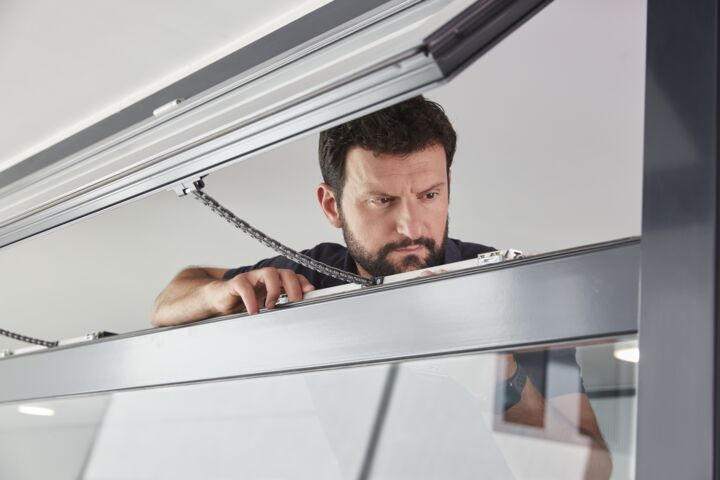
A typical service visit begins with the service technician checking in with the operator or facilities manager and reviewing the system using the operations log, maintenance records and system documentation. This involves checking whether any faults have arisen since the last maintenance, such as error messages or other operational irregularities. The actual inspection and maintenance then begins. The expert works his way through the system step by step, inspecting the supply unit, operating elements and opening systems, and carries out the prescribed visual inspections, functional tests and maintenance tasks – in accordance with the manufacturer’s instructions – including checking for wear, damage and dirt, as well as making any necessary adjustments.
Finally, the work carried out and the results of the maintenance are recorded in the logbook or maintenance log. Any defects identified are recorded, discussed with the operator and, where necessary, rectified through appropriate repair measures. If repairs are not made, recommendations are made for their rectification.

Participants in our smoke and heat extraction system training courses receive a clear checklist from the GEZE Academy for testing the functionality of GEZE smoke and heat extraction systems, to ensure compliance with legal requirements and proper operation and documentation.
View our training coursesObligations for operators
Operators are subject to a duty of care and must ensure that their smoke and heat extraction systems function reliably. © Karin Fiedler / GEZE GmbH
Operators are subject to a duty of care and must ensure that their smoke and heat extraction systems do not pose any avoidable hazards and function reliably in an emergency. In order to keep smoke and heat extraction systems in a safe and operational condition, operators of such systems are therefore required, in addition to annual maintenance carried out by a qualified specialist firm, to carry out additional regular operator checks in the form of visual inspections and functional tests, depending on the building, federal state and system design. The relevant testing regulations, the manufacturer’s specifications and the requirements set out in the fire protection concepts and the statement of approval are decisive.
Faults in a smoke and heat extraction system are usually identified during a professional inspection or maintenance check and recorded in the inspection book. Typical indications may include error messages on the SHEV control panel, faults in individual components, or anomalies detected during functional tests.
Regardless of the annual maintenance, however, operators are obliged, as part of their duty to ensure public safety, to carry out regular visual and operational checks in order to identify any abnormalities at an early stage and take appropriate action. Depending on usage and the type of building, this may need to be done weekly or even daily.
During these regular visual and operational checks, operators and/or facilities managers should pay particular attention to the following points:
- Status displays and messages on operating elements or supply units
- obvious damage or dirt
- unusual noises or malfunctions, particularly in systems with a combined ventilation function, for example during normal ventilation mode
Important: These regular visual and operational checks are no substitute for professional maintenance or inspection.
Are there any liability risks if inspections and maintenance are not carried out?
Operators are required to organise regular maintenance, provide evidence of compliance and rectify any defects. If a smoke and heat extraction system fails during a fire and there is a lack of maintenance or documentation, the operator or the person responsible may be held liable. In an emergency, it becomes clear just how crucial it is for every single component to function properly. A defective or non-functioning smoke and heat extraction window is not just a matter of convenience, for example, but a safety-related fault. Unlike a window used for daily ventilation, as part of a smoke and heat extraction system it fulfils a vital safety function and must be repaired immediately in the event of a fault.
Potential liability risks
- Fines or operational restrictions
- Civil claims, such as those arising from personal injury or damage to property following a fire
- Criminal liability risks where a hazard arises or obligations are breached due to a failure to carry out maintenance
- Insurance issues, including the refusal to pay out in cases of proven breach of duty
The best protection is annual maintenance carried out by a qualified specialist firm, keeping the inspection book up to date, and promptly rectifying any faults.
Stay secure with the right service contract
A customised service contract for your smoke and heat extraction systems ensures that all inspection and maintenance deadlines are reliably met, faults are detected at an early stage, and that you are legally and organisationally covered in the event of an emergency. Ensure that your smoke and heat extraction systems receive professional support and regular maintenance now, and avoid unnecessary risks of downtime and liability.
GET ADVICE NOW AND REQUEST A SERVICE CONTRACT
As a GEZE service contract customer, you benefit from a range of advantages:
- Reduced hourly rates – so you can better plan your budget.
- Reaction time within 24h after an error message – so you can avoid downtimes.
- Quick availability of original parts for GEZE products – eliminating long purchasing lead times.
